
Technical Discipline of Works on Paper: Understanding Working States and Printmaking Process in Sir Claude Francis Barry’s Palace of the Popes, Avignon
Understanding Working States
In fine art printmaking, an impression on paper is only the final piece of a very long, methodical process. Unlike painting directly onto a canvas, where an artist can paint over mistakes or adjust composition with a single brushstroke. Intaglio printmaking requires every decision to be physically incised or bitten into metal. To truly understand the discipline, it is important to examine the progressive working states.
What Are Working States in Fine Art Printmaking?
In printmaking terminology, a “state” refers to any stage in the development of a printing plate at which the artist pulls an impression to check their progress before making further alterations. Each state proof captures a moment in the evolution of the image.
For art historians, curators, and collectors of works on paper, surviving state proofs offer insight into an artist’s creative problem solving. Rather than seeing only the finished edition, we are able to see how light and shadow were created, step by step.
Deconstructing Barry’s Palace of the Popes, Avignon Across States
Featured here is Sir Claude Francis Barry’s Palace of the Popes, Avignon, broken down across its stages of development:
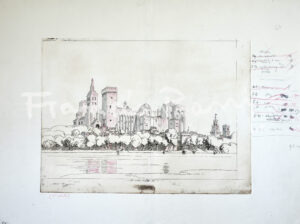
State 1: Line Etching and Architectural Structure
In State 1, Barry begins with line etching. At this 1st stage, there is no shading, only draftsmanship mapping light and structure across the palace facade and river below. Working with an etching needle through a waxy acid resistant ground, Barry establishes the composition of the scene, translating the architecture of Avignon onto the copper surface in reverse.
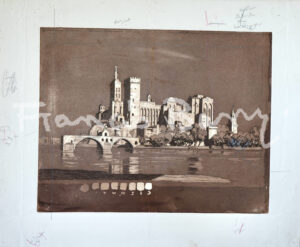
States 2 – 3: Timed Acid Baths and Barry’s Step Wedge Test Scale
Between States 2 and 3, the plate enters its most experimental phase. Included in the full impression is a rare piece of process documentation: Barry’s hand numbered test scale, which he marked I to IV along the margin of the plate.
Each section of this step wedge test represents a carefully timed immersion in the acid bath, which controls how deep the metal was etched to hold varying densities of ink. Longer exposure to the acid creates deeper recesses in the copper, allowing the plate to retain more ink and print velvety, dark shadows; shorter immersions yield delicate mid-tones. Seeing this calibration strip preserved directly on a working proof displays the precision behind Barry’s dramatic lighting.
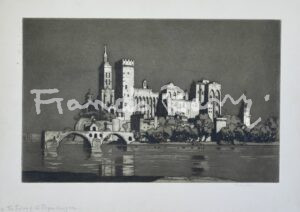
The Final Impression: Aquatint Atmosphere and Depth
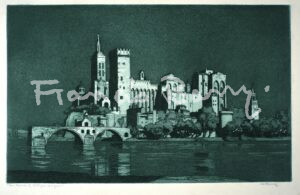
The Final Impression represents a huge transformation from the 1st State. Building upon the structural line work, heavy aquatint tones give weight and chiaroscuro to the sky, the fortress walls, and the reflections across the Rhône. By fusing powdered rosin onto the copper plate and biting it in stages, Barry achieves rich, painterly washes, turning a linear architectural study into an atmospheric print.
Why State Proofs Matter for Provenance and Collectors of Works on Paper
Works on paper are so delicately produced, and this progression demonstrates Barry’s technical skill and steady hand at printmaking. Every stage carried the risk of over-biting the copper plate and ruining weeks of work, making his command of both line etching and aquatint all the more remarkable.
Discovering preserved state proofs and step wedge tests within an archive establishes provenance and deepens the value of an edition. For collectors and institutions, these rare working impressions tell the complete story of how a print came into being. Connecting the viewer to the artist’s studio, his technical experiments, and his relentless pursuit of tonal perfection.